Weather · 10 min read
What is the weather like at Europe's Christmas markets in December?
Expect a few degrees above freezing by day, frost or close to it at night, and seven to eight and a half hours of daylight. The markets do their best trade after dark, so pack for standing still outside in the cold.
By Adam BognarPublished
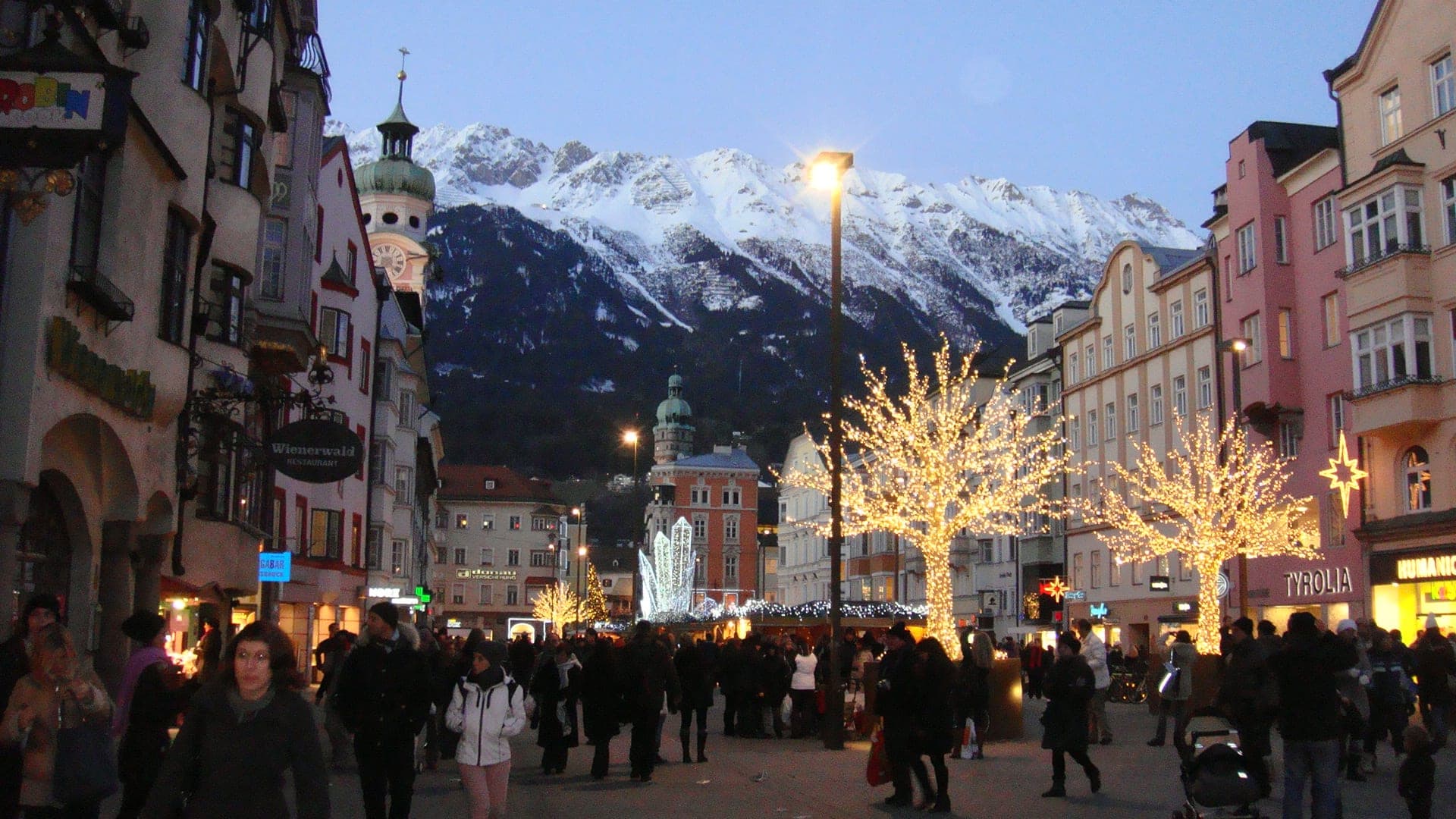
December at Europe's Christmas markets sits a few degrees above freezing by day and close to zero at night, and the sun is up for seven to eight and a half hours around the solstice. Average December highs in the climate normals run from 3.5 °C in Budapest to 6.9 °C at Amsterdam's Schiphol station. The coldest nights in the table come in Innsbruck, where the average low is −2.2 °C. The big city markets in our files light up by mid-afternoon and trade until 21:00 or later, so dress for two or three hours of standing outside in the dark, and wear boots that grip on wet stone.
The temperatures, rain and sunshine below come from one station per city in each national weather service's climate normals, which average the years 1991 to 2020. Copenhagen is the exception. Denmark's DMI still calls its 1991–2020 figures provisional, so that row uses DMI's 1961–1990 normals. Germany's DWD publishes no monthly highs, lows or rain days in its open normals, and the German rows carry the monthly mean only. Daylight is our own figure. We computed sunrise and sunset for 21 December 2026 at each town centre's coordinates with the astronomical formulas the SunCalc library uses, which land within about a minute at these latitudes.
| City and station | High / low (mean), °C | Rain or snow | Wet days | Sunshine | Daylight, 21 Dec | The catch |
|---|---|---|---|---|---|---|
| Vienna, Innere Stadt | 4.7 / 0.7 (2.8) | 39.9 mm | 7.7 | 57.1 h | 8 h 20 min | Its 3.6 m/s mean wind beats GeoSphere's other Austrian stations in our files |
| Salzburg, Freisaal | 4.7 / −2.0 (1.4) | 86.5 mm | 12.6 | 71 h | 8 h 24 min | It has the second-wettest December in the table |
| Innsbruck, University | 4.5 / −2.2 (1.2) | 53.2 mm | 8.8 | 90.6 h | 8 h 28 min | Nights are the coldest in the table, and snow lies on 11.2 days |
| Munich, city station | Not published (1.8) | 58.5 mm | Not published | 66.4 h | 8 h 21 min | The mean barely clears freezing at the 515 m station |
| Nuremberg, airport | Not published (1.6) | 48.8 mm | Not published | 44 h | 8 h 09 min | The sun shines for 44 hours in the whole month |
| Dresden, Klotzsche | Not published (1.7) | 44 mm | Not published | 60.1 h | 7 h 54 min | The sun sets at 16:01 on 21 December (computed) |
| Berlin, Tempelhof | Not published (2.3) | 44.2 mm | Not published | 41.3 h | 7 h 39 min | The sun sets at 15:55 on 21 December (computed) |
| Cologne, Stammheim | Not published (4.7) | 72.4 mm | Not published | 41 h | 7 h 55 min | It is the wettest German station here and gets the least sun of any station that publishes it |
| Strasbourg, Entzheim | 5.9 / 0.8 (3.3) | 45.2 mm | 10.2 | 44.2 h | 8 h 17 min | The sun shines for 44.2 hours in the month |
| Colmar, INRAE | 6.2 / 0.3 (3.3) | 41.9 mm | 8.8 | Not published | 8 h 21 min | Nights sit just above freezing |
| Basel, Binningen | 5.7 / 0.4 (2.9) | 65 mm | 11 | 54.2 h | 8 h 26 min | Rain or snow falls on 11 days |
| Zurich, Fluntern | 4.0 / −0.5 (1.7) | 83.4 mm | 11.5 | 47.1 h | 8 h 27 min | It ranks third-wettest in the table |
| Brussels, Uccle | 6.6 / 2.1 (4.3) | 87.4 mm | 19.4 (from 0.1 mm) | 48.58 h | 7 h 56 min | It has the wettest December in the table |
| Amsterdam, Schiphol | 6.9 / 1.9 (4.6) | 81.7 mm | 14.1 | 58.2 h | 7 h 41 min | It has the most wet days at the 1 mm mark |
| Copenhagen, airport | 3.7 / −0.5 (1.8) | 47 mm | Not published | Not published | 7 h 01 min | It has the shortest day, and its figures date from 1961–1990 |
| Budapest, Pestszentlőrinc | 3.5 / −1.4 (0.8) | 40 mm | Not published | Not published | 8 h 26 min | Its highs and its mean are the coldest in the table |
Wet days count days with at least 1 mm of rain or melted snow. Brussels is the exception: the Royal Meteorological Institute (KMI) counts from 0.1 mm, so its 19.4 can't be set against the others. "Rain or snow" is the month's total precipitation. Each normal is a 30-year average for one station, and many of these stations stand at an airport or on a hill outside the centre, so any given week in December can run several degrees either side of the figures. Each city's link opens its station page, which says where the station stands and which series it lacks.
Darkness falls before 17:00 in every city in the table
Our computation puts sunset on 21 December 2026 at 15:39 in Copenhagen and 15:55 in Berlin. Vienna follows at 16:03. Basel sits near the western edge of its time zone, and no city in the table keeps the sun longer: it sets there at 16:41. Civil dusk, when the sun drops 6° below the horizon and the street lights take over, comes 35 to 50 minutes after sunset in these cities. On 1 December the sunsets fall within a few minutes of those times, and sunrise comes about 20 minutes earlier than at the solstice.
That early dark sets the rhythm of a market day. Most markets open at 10:00 or 11:00, and the crowds build once the stall lights and the tree come on. The Dresden Striezelmarkt and the Nuremberg Christkindlesmarkt trade until 21:00 every day of their 2026 runs. Vienna's Rathausplatz market goes on until 22:00, and Christmas in Tivoli in Copenhagen stays open to 23:00 on Fridays and Saturdays. A village market on a weekday needs more care. In Seiffen the weekday stalls of the Seiffener Weihnacht close at 17:00, about a quarter of an hour after dusk, and only Saturdays run to 20:00.
Spend the daylight on whatever needs it, such as a cathedral's windows or the train to the next town. Then reach the main square around 16:00 and you'll see it once in blue light and again fully lit.
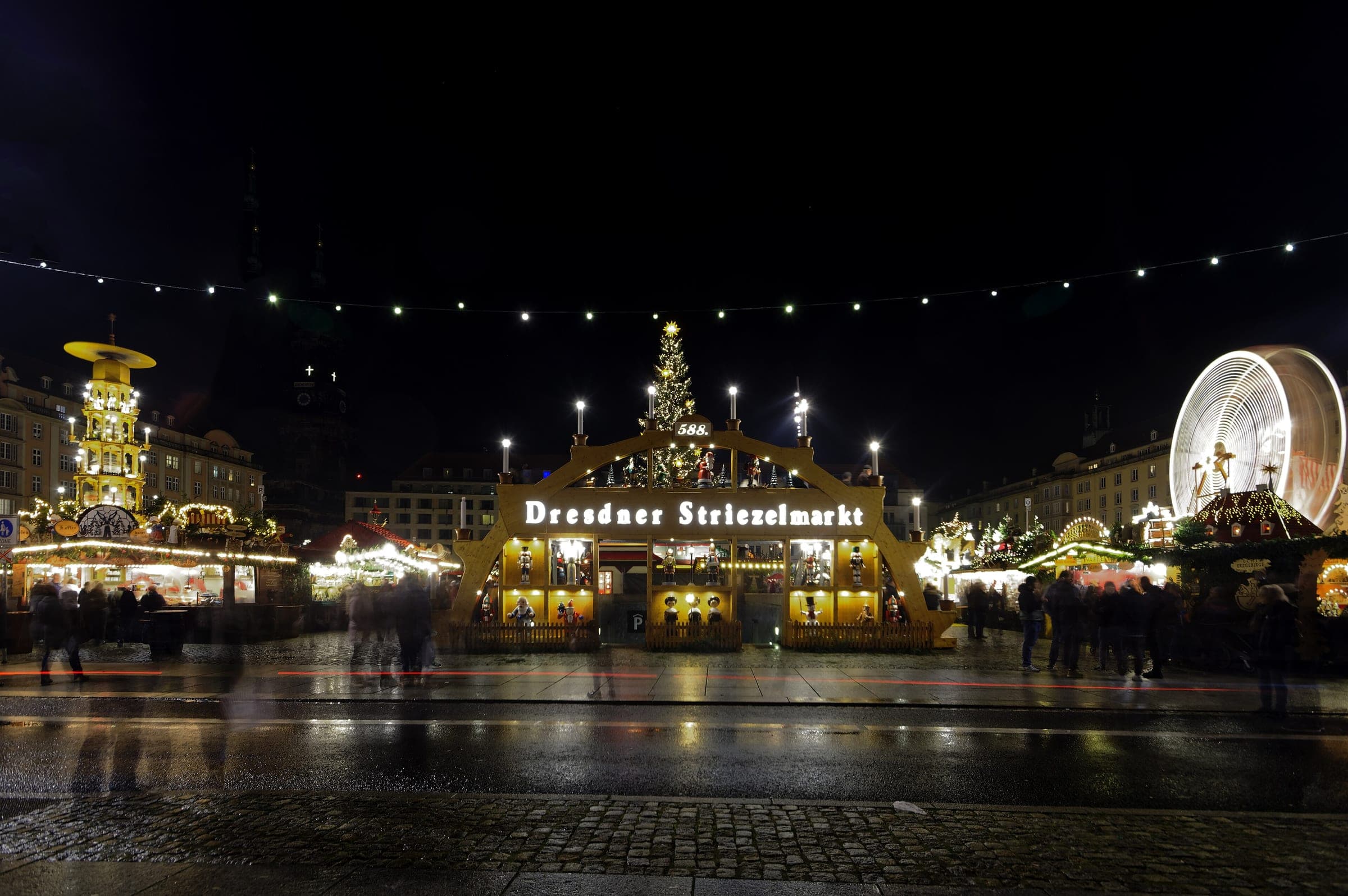
Dress for two hours of standing still
A market keeps you on your feet without moving you much. You queue for a sausage and then stand at a high table with a mug of Glühwein while a choir warms up, and the cold works up from the ground through your soles. At Innsbruck's average low of −2.2 °C, an hour of that is enough to make your toes ache.
Dress in layers, because you'll duck in and out of warm shops and churches all evening. A thermal or merino base layer goes under a wool or fleece mid-layer. Over both, wear an insulated jacket long enough to cover your hips. Wear a hat that covers your ears. Bring gloves thin enough to work a phone, or liner gloves under mittens, since you'll be handling coins and mug deposits all night. Wool socks are the best thing in the bag. Pack a spare pair for the evening, because socks that got damp in an afternoon shower turn cold the moment you stop moving. Chemical hand warmers weigh almost nothing and earn their place on the coldest nights in Innsbruck or Budapest.
A mug of Glühwein warms your hands for about ten minutes. Alcohol also opens the blood vessels in your skin, so you feel warmer while your body loses heat faster. Swap every other round for hot chocolate or the alcohol-free punch most stalls sell, and eat something hot.
Pick boots that grip on wet cobbles and ice
Old-town squares are mostly paved in cobbles or stone setts. In December they are often wet, and around the drink stalls they turn slick with spilled punch. Leather soles and smooth fashion boots slide on that. Choose waterproof boots with a rubber sole and a deep tread. Buy them half a size roomy if you'll wear thick socks, and break them in before the trip.
Snow and ice matter most in the Alpine towns. GeoSphere's normals count 11.2 days with snow cover at Innsbruck in December and 7.5 at Graz. Brussels records snowfall on 3.7 December days. Our files for the German, Danish and Hungarian stations carry no snow series at all. For mountain villages and castle markets on a hill, pack slip-on ice cleats that stretch over your boots. They cost little and fold flat. Take them off on stone floors indoors, where the metal studs slide.
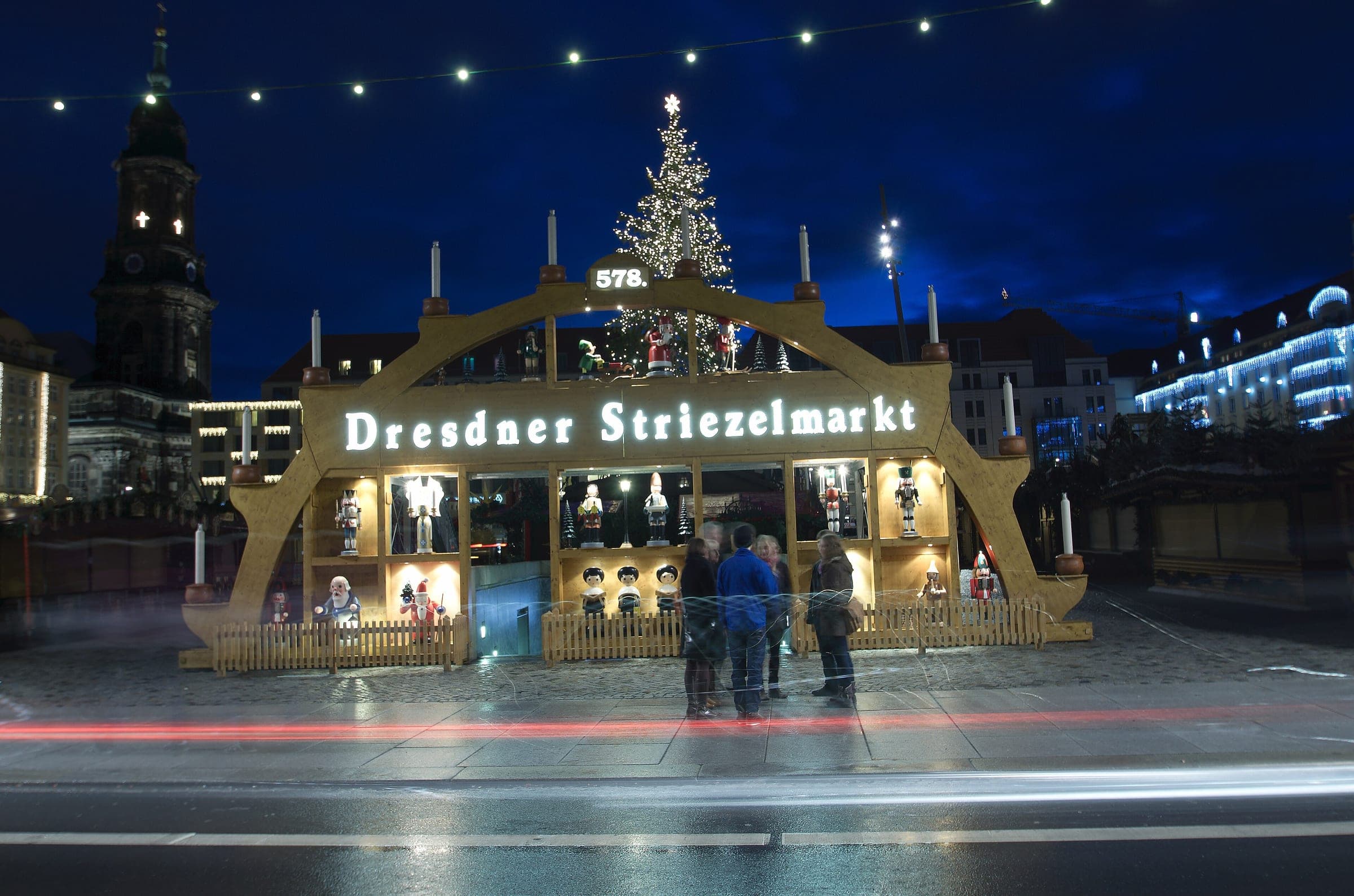
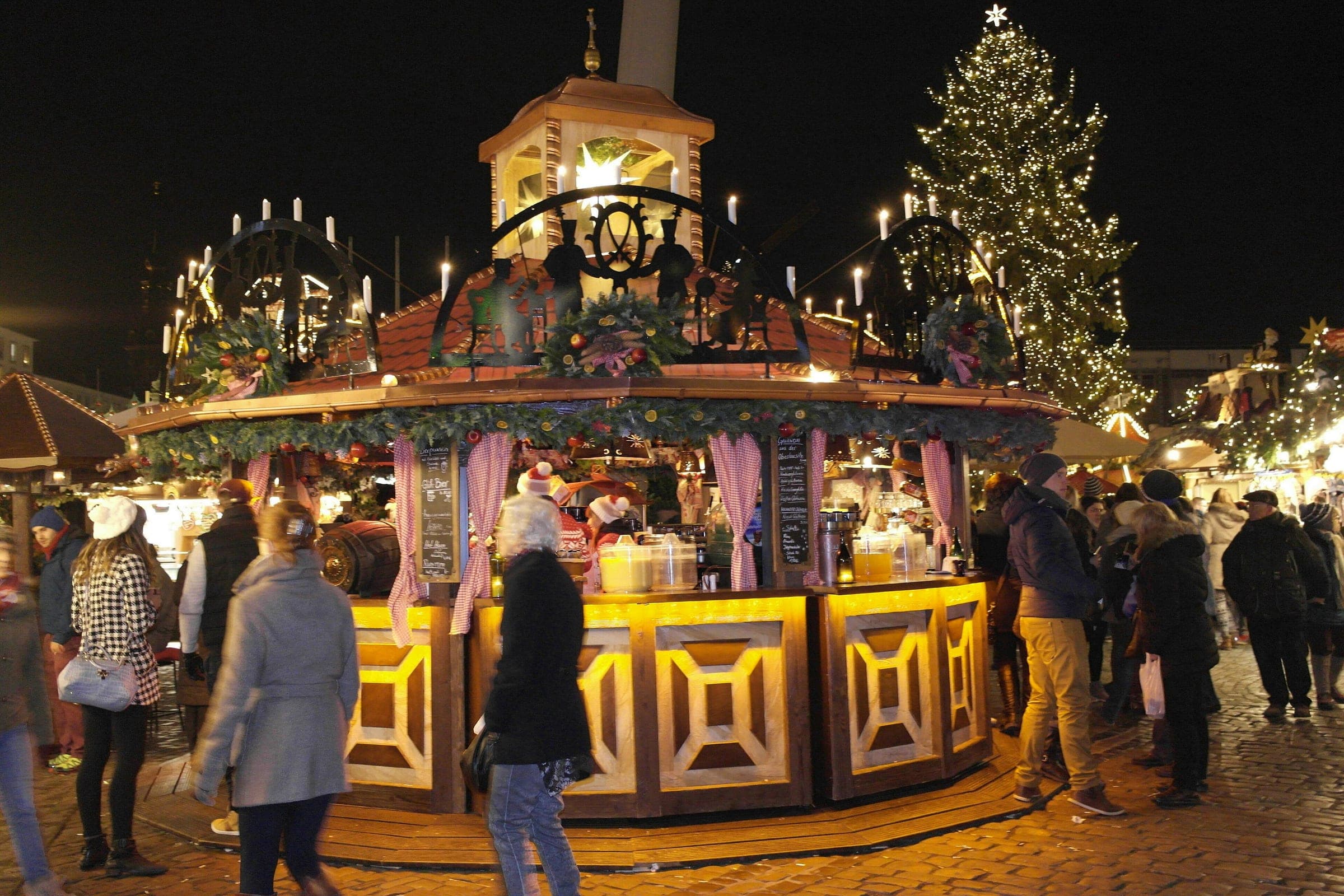
Leave the umbrella at the hotel
An open umbrella in a crowded market lane puts its spokes at the eye height of the person next to you, and it leaves you no free hand for a mug. A waterproof jacket with a good hood does the job better. The stall roofs overhang the lanes, so in a light shower you can stand under the eaves while you eat.
Brussels (87.4 mm) and Salzburg (86.5 mm) are the wettest cities in the table, so plan one covered option for a wet day there. The Gemeentegrot Christmas Market in Valkenburg runs inside a marl quarry under the Cauberg, with timed tickets at weekends. Zurich's Polarzauber fills the hall of the main station from 19 November to 24 December 2026. Museums and concerts fill a rainy afternoon in any of these cities.
Storms can shut a market for an afternoon
Organizers close markets when a storm warning comes in, because stall roofs and light rigs can come down in strong gusts. On 5 December 2013 Leipzig's market office shut the Leipzig Christmas Market at 15:30 as storm Xaver arrived, after the German weather service (DWD) forecast gusts of up to 100 km/h, according to the city's notice published in the Leipziger Internet Zeitung. The stalls reopened the next afternoon. The market's own website and social media carry news of a closure first.
Light trails make their own rules. Christmas Garden Berlin and Christmas Garden Stuttgart run in any weather and refund nothing for rain, and LUMAGICA Innsbruck goes ahead in rain or snow on the same terms. In Lyon, the Parc de la Tête d'Or closes during the Fête des Lumières when the weather turns bad. Warm spells cause trouble too. The organizer of the Graz ice nativity keeps spare sets of figures in case a mild spell softens the carved ice.
Check the warnings on the morning you travel. In Germany the DWD's warning map shows them district by district, and Meteoalarm gathers the national weather services' warnings for the rest of Europe on one map.
River levels touch a different kind of trip. A Christmas market cruise on the Rhine or the Danube depends on the water under the ship, and the cruise operator decides what happens when a river runs too high or too low for it to pass. Germany's federal waterways administration publishes live gauge readings on PEGELONLINE if you want to watch the Rhine in the weeks before you sail. Read your cruise contract for what it promises when the ship can't continue.
Read your travel insurance before you book
A December trip carries risks a summer one doesn't. A storm can close a market for a day, and a rail strike can cancel the train between two market towns. Policies treat these differently, so read the wording before you buy. Check whether it covers cancellations and extra nights caused by severe weather or a strike. Then check whether it pays anything at all when an event you planned the trip around is cancelled. Book trains and hotels with free cancellation where you can, and keep the organizer's notice if a market or a cruise changes its plans, so you have it for a claim.
Quick answers
How cold is it at the Christmas markets in December?
December at the Christmas markets averages a few degrees above freezing by day. In the 1991–2020 normals the average high runs from 3.5 °C in Budapest to 6.9 °C at Amsterdam Schiphol, and the average low from −2.2 °C in Innsbruck to 2.1 °C in Brussels.
Does it snow at the Christmas markets?
Snow is likeliest in the Alpine market cities. GeoSphere's 1991–2020 normals count 11.2 December days with snow cover in Innsbruck and 7.5 in Graz, and Brussels averages 3.7 December days with snowfall. Our German, Danish and Hungarian station files carry no snow figures.
What time does it get dark at the Christmas markets?
It gets dark before 17:00 in every Christmas market city we compared. Our computed sunset for 21 December 2026 is 15:39 in Copenhagen, 15:55 in Berlin, 16:03 in Vienna and 16:41 in Basel, and civil dusk follows 35 to 50 minutes later.
Which Christmas market city is wettest in December?
Brussels is the wettest of the sixteen Christmas market cities we compared, with 87.4 mm of December precipitation at Uccle in the 1991–2020 normals. Salzburg follows with 86.5 mm and Zurich with 83.4 mm.
Should I bring an umbrella to a Christmas market?
A hooded waterproof jacket works better than an umbrella at a crowded Christmas market. Umbrella spokes sit at other people's eye height and leave you no free hand for a mug, and the stall roofs give shelter in a light shower.
Can bad weather close a Christmas market?
Yes. Organizers close Christmas markets for storm warnings, as Leipzig did at 15:30 on 5 December 2013 when storm Xaver brought forecast gusts of up to 100 km/h. The market reopened the next afternoon, and the organizer's own website posts closures first.
We write from operators’ and agencies’ own pages, open map data and published research, and we date every fact we check. How we research.
Sources (28)
- https://klimaportal.geosphere.at/klimamittelwerte_1991_2020.html
- https://klimaportal.geosphere.at/klimamittel/klimanormalperiode_19912020.xlsx
- https://opendata.dwd.de/climate_environment/CDC/observations_germany/climate/multi_annual/mean_91-20/Temperatur_1991-2020.txt
- https://opendata.dwd.de/climate_environment/CDC/observations_germany/climate/multi_annual/mean_91-20/Niederschlag_1991-2020.txt
- https://opendata.dwd.de/climate_environment/CDC/observations_germany/climate/multi_annual/mean_91-20/Sonnenscheindauer_1991-2020.txt
- https://meteofrance.s3.sbg.io.cloud.ovh.net/data/synchro_ftp/REF_STATION/FICHECLIM_67124001.pdf
- https://meteofrance.s3.sbg.io.cloud.ovh.net/data/synchro_ftp/REF_STATION/FICHECLIM_68066001.pdf
- https://data.geo.admin.ch/ch.meteoschweiz.klima/normwerte/normwerte.zip
- https://www.meteoswiss.admin.ch/climate/the-climate-of-switzerland/climate-normals/normal-values-per-measured-parameter.html
- https://www.meteo.be/nl/klimaat/klimaat-van-belgie/klimaatnormalen-te-ukkel/neerslag/neerslagtotaal
- https://www.meteo.be/nl/klimaat/klimaat-van-belgie/klimaatnormalen-te-ukkel/neerslag/neerslagdagen
- https://www.meteo.be/nl/klimaat/klimaat-van-belgie/klimaatnormalen-te-ukkel/neerslag/sneeuwdagen
- https://cdn.knmi.nl/knmi/asc/normalen2021/klimaattabel/Normalen_240_H.csv
- https://www.dmi.dk/fileadmin/user_upload/Rapporter/TR/1999/tr99-5.pdf
- https://www.dmi.dk/fileadmin/user_upload/Rapporter/TR/1997/tr97-8.pdf
- https://www.dmi.dk/fileadmin/Rapporter/2026/DMIRep26-04.pdf
- https://www.met.hu/eghajlat/magyarorszag_eghajlata/varosok_jellemzoi/Budapest/
- https://www.l-iz.de/melder/bewegungsmelder/2013/12/Wegen-Orkan-Xaver-Leipziger-Weihnachtsmarkt-62524
- https://www.dwd.de/DE/wetter/warnungen_gemeinden/warnWetter_node.html
- https://www.meteoalarm.org/en/
- https://www.pegelonline.wsv.de/
- https://striezelmarkt.dresden.de/index_de.php
- https://www.christkindlmarkt.at/
- https://www.christmas-garden.de/berlin/
- https://www.christmas-garden.de/stuttgart/faq/
- https://lumagica.com/de/standorte/innsbruck
- https://www.graztourismus.at/advent/de/advent-veranstaltungen/eiskrippe_evt_2360
- https://www.fetedeslumieres.lyon.fr/fr/faq/foire-aux-questions
Places in this piece
Read next
guide · 23 min read
When do Europe's Christmas markets open and close in 2026?
Vienna and Copenhagen open first, on 6 November 2026, and Cologne's Heumarkt keeps its stalls up until 10 January 2027. Every row below names who published the date.
guide · 10 min read
When do Christmas markets open in Germany in 2026?
Totensonntag falls on 22 November in 2026. Most German markets open in the week after it, and the date of a city's market comes from a rule you can read ahead.
guide · 12 min read
Which Christmas markets stay open until New Year and Epiphany?
Budapest stays up until 03:00 on New Year's Eve, and 15 markets with confirmed dates are still open on Epiphany, 6 January 2027.